Past, present, and future sport cars makes and models from around the world. In-depth coverage and reviews of auto shows, racing events, concours d'elegance, and auctions, also vehicle information from concept to production.
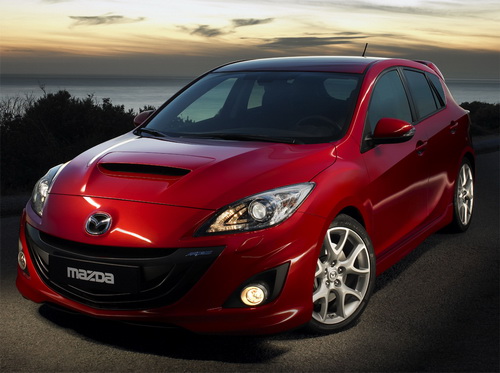
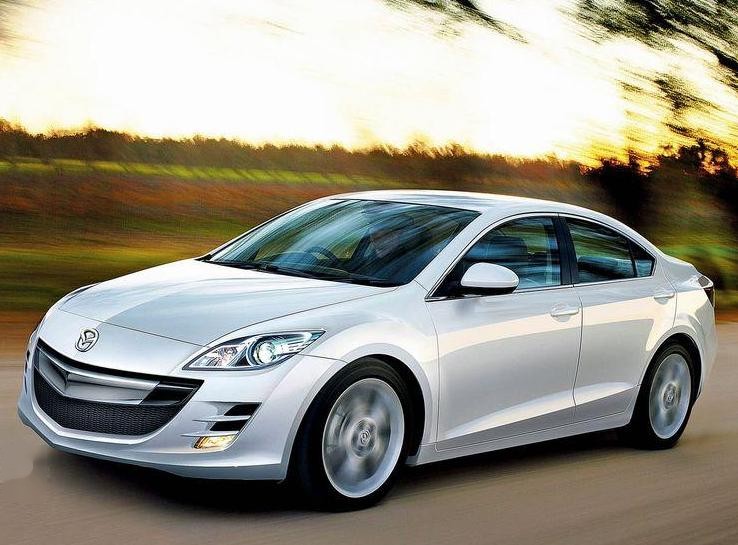
Mazda Motor Corporation announced it would withdraw for repairs (recall) as many as 494,500 Mazda3 Axela or any other names around the world, including Indonesia. Repairs carried out due to an electronic system found damage to the wiper (swabs glass) front so it does not work.
Drawn is the production of Mazda3 in January 2008 to July 2010 from Japan. It sounds trivial, but quite inconvenient when it rains, it could jeopardize the trip because the views are limited. A spokesman for Mazda, as reported by Reuters on Wednesday (15/06/2011), admitted there was no reported accidents related to this damage by consumers.
If parsed, the majority of the taxable Mazda3 recall spread in North America, which is 157,700 units, 91,600 units followed by Europe, China (84,000 units), and 20,000 in Japan. In Indonesia alone, the number of sales of the hatchback is not too significant, in his final year, 2009, Gaikindo data shows there are only two units sold. In 2010, PT Mazda Motor Indonesia decided to stop selling this model to the market.
Mazda sales in Indonesia is still below compared with other Japanese brands. Even so, retail sales recorded last May that 710 units, up 10 units compared to the previous month. So also wholesale reached 777 units, an increase compared to April with a record 606 units.
Of the total retail, the Mazda2 is still the backbone with Raihan 61 percent or 431 units and if one added a sedan variant of 473 units. Other products, such as BT-50 sold 168 units, 39 units CX-7, CX-9 of 16 units, 12 units Mazda6 and RX-8 2 units.
Mazda sales in Indonesia is still below compared with other Japanese brands. Even so, retail sales recorded last May that 710 units, up 10 units compared to the previous month. So also wholesale reached 777 units, an increase compared to April with a record 606 units.
Of the total retail, the Mazda2 is still the backbone with Raihan 61 percent or 431 units and if one added a sedan variant of 473 units. Other products, such as BT-50 sold 168 units, 39 units CX-7, CX-9 of 16 units, 12 units Mazda6 and RX-8 2 units.
According to Mazda in a release, today (14 / 6), his little sales CX-7, CX-9, and the Mazda6 affected supplies from Japan. But Mazda is optimistic that the production of supplies for the three models will begin to recover in June 2011.
Yoshiya Horigome, President Director of PT. Mazda Motor Indonesia, explained that the record sales this time gives interesting indications on the market reaction to Mazda. "Mazda began the year with a full step on the gas as car manufacturers (the sole agent of shareholders) of the fastest growing based on data Gaikindo. We believe that this growth not only give a signal to the record 2011 sales, but also on the growth of confidence which is very significant for Mazda in Indonesia. "
According to Mazda in a release, today (14 / 6), his little sales CX-7, CX-9, and the Mazda6 affected supplies from Japan. But Mazda is optimistic that the production of supplies for the three models will begin to recover in June 2011.
Yoshiya Horigome, President Director of PT. Mazda Motor Indonesia, explained that the record sales this time gives interesting indications on the market reaction to Mazda. "Mazda began the year with a full step on the gas as car manufacturers (the sole agent of shareholders) of the fastest growing based on data Gaikindo. We believe that this growth not only give a signal to the record 2011 sales, but also on the growth of confidence which is very significant for Mazda in Indonesia. "
Mazda Motor Corporation (MMC) through its official website on Monday (4/18/2011), the state will launch a new product CX-5 at the end of the third-quarter 2011. Crossover was developed from concept car Mazda Minagi who has appeared at the auto show in Geneva, March 2011. MMC said the CX-5 produced the latest design brought the concept of "Kodo-Soul of Motion" and the new technology package, called SKYACTIV Mazda.
Kodo own new concept introduced in SHINARI Mazda has ever shown at the Paris Motor Show, the end of September last year. From the picture shown looks of the CX-5 compact, compact, and stylish. Mazda CX-5 position in the segment complementary variants sport utility vehicle (SUV) before, CX-9 and CX-7, and will target the consumer segment of the lowest (entry level) with a more compact dimesi. Currently no additional information, either type of engine, transmission, and chassis. One thing is for sure, debuted a new prime CX-5 carried out in the event the Internationale Automobil-Ausstellung, or better known as the Frankfurt Motor Show, Germany, September 2011. For the period, the unit was just removed from 2012 as a global product.
The CX-7 is a mid-size crossover SUV model from Mazda, the production version of the MX-Crossport concept car. The CX-7 is built in Hiroshima, Japan, starting in early 2006. The CX-7 was shown publicly for the first time at the 2006 Los Angeles Auto Show in January. Production officially began on February 20 at Mazda's Ujina#2 factory in Hiroshima. The CX-7 went on sale in spring 2006 as a 2007 model. It is also Mazda's first mid-size SUV since the Navajo was discontinued in 1994. The CX-7 receives an all-new platform instead of sharing the Ford/Mazda CD3 platform used by the larger Mazda CX-9/Ford Edge/Lincoln MKX crossovers as well as the Mazda6. It uses the front suspension of the Mazda MPV minivan, with the rear suspension from the Mazda5. Many of the all wheel drive components come from the Mazdaspeed6. It shares its turbocharged engine with the Mazdaspeed6. It uses a 6-speed automatic transmission. The CX-7 currently slots between the Tribute and the CX-9. Power comes from the same 2.3 L straight-4 MZR engine used in the Mazdaspeed3 and Mazdaspeed6 coupled with a 6 speed Aisin automatic transmission, and tuned to produce 244 hp or 182 kW (Australian model 175 kW) at 5000 RPM and 258 ft·lbf (350 N·m) of torque at a low 2500 rpm, 99% of the maximum torque is available to 5000 rpm. The MZR 2.3L DISI turbo engine found in the Mazdaspeed3 and Mazdaspeed6 has been retuned in the North American-Spec CX-7 to deliver torque at a lower RPM for less turbo lag off the line. This was achieved thanks to a redesigned, smaller KO4 turbocharger. UK-Spec CX-7's feature the same, larger KO4 turbocharger and transmission found in the Mazdaspeed line.
The CX-7 features fully independent suspension, four-wheel ventilated disc brakes with standard anti-lock brakes, stability control and traction control, and a choice of either front wheel drive or Mazda's Active Torque-Split all wheel drive system. With the Active Torque-Split system, two computer-controlled magnetic clutches feed up to 50% of the engine's torque to the rear wheels. The Australian combined cycle official fuel economy is 11.5 L/100 km (24.6 mpg-imp; 20.5 mpg-US). Fuel Economy varies among different tests, owners, and models, but drivers report a typical range between 10.0 L/100 km (28.2 mpg-imp; 23.5 mpg-US) and 18.0 L/100 km (15.7 mpg-imp; 13.1 mpg-US). As of the 2010 model, there are four trim levels (model): * iSV is the base version, priced from US$21,550 * iSport is the next version, priced from $24,385 * sTouring is the upscale version, priced from US$26,135 * sGrand Touring is the top version, priced from US$26,935 * Only Touring and Grand Touring models are available with All-Wheel Drive and only these two trims are offered with the 2.3L turbocharged engines while the SV and Sport trims come with a 2.5L MZR naturally-aspirated DOHC four-cylinder. Canadian models and pricing: * GS Front-Wheel Drive - $32,095 CDN * GS All-Wheel Drive - $34,095 CDN * GT Front-Wheel Drive - $35,295 CDN * GT All-Wheel Drive - $37,295 CDN Australian models (AWD only) pricing: * "CX-7 Classic" Base trim starts at AUD $40,610 * "CX-7 Luxury" Top trim starts at AUD $46,460
This is an update to the original. The exterior design features revised front and rear fascias with the front adopting the larger five-point grille design similar in appearance to the recently redesigned RX-8, MX-5 and Mazda3/Axela. The new interior features redesigned gauges with blackout meters that feature three-dimensional dials, a 3.5 inch super-twisted nematic (STN) monochrome and 4.1-inch thin-film transistor (TFT) colour Multi Information Display (MID), (positioned at the top of the instrument panel), Bluetooth compatibility, and a Blind Spot Monitoring System. The car was unveiled at the 2009 Canadian International Auto Show. The diesel version now includes a manual transmission, and has been on sale in Europe since 2009. Engine choices include 2.5 litre MZR 4-cylinder engine that produces 161 hp (120 kW) and 161 lb·ft (218 N·m) of torque and the same MZR 2.3L DISI Turbo engine from before. Transmission is a 5-speed automatic for the 2.5 and a 6-speed automatic for the 2.3 DISI Turbo engine.The CX-7 reused the name RX-7, (which was a sports car that was discontinued and replaced by RX-8), but the first letter, 'R' ('R' means rotary engine), was changed to 'C' ('C' means crossover SUV).
The Mazda unveiled the MX-5 GT, the race will take place at the British Championships resistance Britcar MSA. The construction was done with the help of Jota Sport, which is to be run on behalf of Mazda in the league in 2011.
More than 400 hours were needed to make 17 times more powerful chassis to meet the requirements of the FIA. By using carbon doors and windows in polycarbonate Mx5 weighs 850 pounds.
The competition once again roll cage, seat belts, stop button for electrical, fire extinguisher, alloy wheels, steering and safety hood and trunk, all approved by the FIA.
Mechanical delivers 279 horses combined with a sequential gearbox 6-speed manual transmission with paddles. The 0-60 mph (96 kph) makes in 3 seconds with a top speed of 257.5 mph. Will make his debut Saturday, March 26 in the 3-hour race Silverstone.
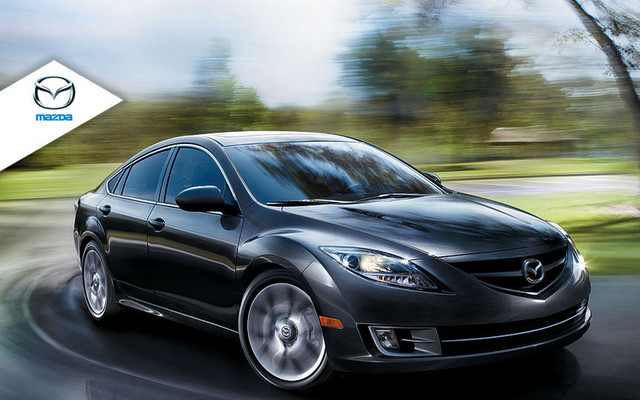
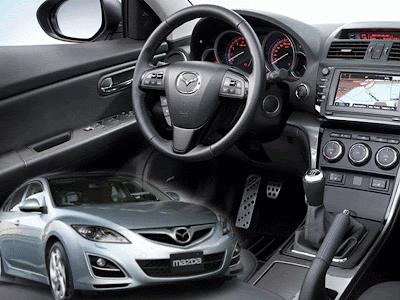
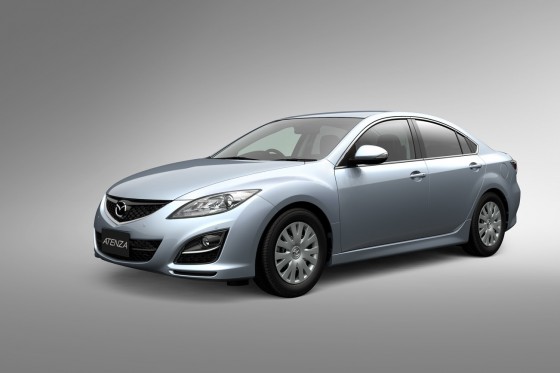
The Mazda6 or Mazda 6 (known as the Mazda Atenza in Japan) is a mid-size car produced by the Japanese car manufacturer Mazda since 2002. The Mazda6 has sold over one million units worldwide since its introduction, hitting that sales milestone faster than previous Mazdas. The Mazda6 was the first example of the company's new Stylish, Insightful, and Spirited design philosophy followed by the Mazda2 in December 2002, RX-8 in August 2003, Mazda3 in January 2004, Mazda5 in the summer of 2005, MX-5 in October 2005, and Mazda CX-7 in November 2006. The Mazda6 is the successor of Mazda 626, also known as Mazda Capella and Mazda Cronos. The 2002 Mazda6 is essentially the 4th generation Mazda 626 as the Mazda6 continues on the G-platform, progressing from the GF-platform 626/Capella to the GG-platform Mazda6. The Mazda6 is currently raced in the SCCA Pro Racing World Challenge GTS class. Mazda finished first in the manufacturer's championship standings. Mazda6 drivers also finished first and second in the Touring Car driver points.
The model lineup consists of a four-door sedan, a five-door liftback and a five-door station wagon, marketed in North America as the "Sport Sedan", "5-Door" and "Sport Wagon", respectively. In Australia, the lineup starts with Limited, available only as a sedan. Then comes the Classic, available in sedan, hatch or wagon. The Luxury model is next available in sedan and hatch versions. Topping the range is the Luxury Sports model, available only as a hatch. In New Zealand the lineup consisted of 2.0L GLX (sedan only), 2.3L GSX (sedan, hatch, and wagon), and the range-topping 2.3L Limited (sedan and hatch). When it arrived in North America, it was first sold as a 2003 model in the United States and as a 2004 model in Canada. In Europe, the luxury sports model was available as a 136 hp (101 kW) direct injection turbodiesel ("DITD") station wagon up until 2007. As of 2008, the European Mazda catalog lists only the "Sport" version of the 146 hp (109 kW) turbodiesel station wagon, while the "Luxury Sport" version has been dropped. Drivetrain combinations include the Mazda MZR engine in configurations of 1.8 L (L8-DE), 2.0 L (LF-VE) and 2.3 L (L3-VE), initially with a five-speed manual or four-speed automatic transmission (with sequential-automatic option, dubbed the "Four-Speed Sport AT"). In the US domestic market a 3.0 L Duratec 30 V6 engine is also available with a five-speed manual or five-speed automatic (with sequential-automatic option, dubbed the "5-Speed Sport AT"). European and Australian versions also feature a four-cylinder turbodiesel that comes with a six-speed manual transmission and produces significantly more torque than the V6 with much improved fuel economy. In North America, the 5-speed automatic optional on the V6 models is replaced by an Aisin 6-speed automatic for 2005 model year. The four-cylinder model receives a Jatco five-speed automatic in the following year. Power is directed to the front wheels in most markets, although full-time all wheel drive models are available in Japan, Europe and Australia. Not all configurations are available in all areas - for example, the Mazda 6 as released in Australia is available in 2.3L four-cylinder guise only, while the 626 which it replaced was available with a choice of four or six-cylinder engines. The MZI V6 engine was only fitted to vehicles manufactured at Flat Rock, Michigan and destined for the US and Canadian domestic markets. Just as before the Mazda 626 was renamed to Mazda6 Atenza, Ford continues to use the Mazda's G-series platform for the basis of a number of its CD3 platform coded vehicles, including the Ford Fusion, Mercury Milan, Lincoln Zephyr/MKZ, Lincoln MKX, and a range of SUVs and minivans. Ford also plans to offer a hybrid powertrain on the platform. The official Mazda chassis codes are GG (sedan/hatch) and GY (wagon) series - following the 626/Capella in its GF/GW series. Mazda's Hofu plants in Yamaguchi Prefecture, Japan produce the Mazda6 for international markets. In North America, Mazda 6 production is handled at the AutoAlliance International plant which is a joint venture between Ford and Mazda. The first Mazda 6 rolled off this Flat Rock, Michigan assembly line on October 1, 2002, one month after 626 production ended. There are also satellite plants building Mazda 6 models in China and Thailand for their respective local markets. In September 2005, all Australian Mazda 6's received a facelift which included a feature upgrade, 5 speed auto and 6 speed manual transmissions, standard 16" or 17" alloy wheels and minor bodywork upgrades. In China, the Mazda6 is used as the base for the FAW Benteng, also known as Besturn or Hongqi C301, manufactured by the First Automobile Works in Jilin Province.
The 2006 Mazdaspeed Atenza (known as Mazdaspeed6 in North America and Mazda 6 MPS in Europe, South Africa and Australia) is a high-performance version of the Mazda 6. It features a turbocharged version of the 2.3 L MZR I4 which produces 272 PS (200 kW) (European version is detuned to 260 PS (191 kW); the North American version, at 274 hp (204 kW), revised to 270 hp (200 kW) for 2007). All models have 280 lb·ft (380 N·m) of torque. This 2.3 L DISI turbocharged engine features direct fuel injection and conforms to the new Euro 5 emissions standards. It has a revised front fascia with a raised hood, a 6-speed manual transmission, and four-wheel drive. The all wheel drive system uses Mazda's Active Torque Split computer-based control which routes up to 50% of the power to the rear wheels depending on driving conditions. The Mazdaspeed Atenza competed with the Subaru Legacy GT and less directly with the compact Subaru Impreza WRX STi and Mitsubishi Lancer Evolution. Originally scheduled to be launched in June 2005, the Mazdaspeed Atenza was delayed until November. In North America, the Mazdaspeed6 comes in two trim levels; the "Sport" trim with cloth interior and standard key entry and ignition; and the "Grand Touring" trim with leather interior, keyless entry/ignition, and an optional DVD navigation. Automatic climate control is standard, as is a 200 W Bose stereo system featuring seven speakers and a 9 inch subwoofer in addition to an in-dash six-disc CD changer. A sunroof with moonroof feature is optional on the Grand Touring trim. Car and Driver magazine has achieved a 0-60 mph time of 5.4 seconds for this vehicle. The Mazda6 was second place in the 2003 European Car of the Year awards and made Car and Driver magazine's Ten Best list for 2003. The Sport Wagon won the Canadian Car of the Year Best New Station Wagon award, while the Sport sedan won the Canadian Car of the Year Best New Family Car award for 2005. The Atenza Wagon also won What Car?'s Best Estate award in 2004. Also the Mazda6 won the 2003 Semperit Irish Car of the Year. The Mazda6 won the 'Best Mid-size Car (over $28,000)' title in Australia's Best Cars in 2002 and 2003. It came second in 2004, behind the Subaru Liberty, and fifth in 2005 (the Honda Accord Euro was first in 2005). Wheels magazine also awarded the Mazda6 winner of its Active Safety Program in July 2005. In December 2007 in Australia the Mazda6 won the Carsales Peoples Choice award for its class. The Mazda 6 was praised for its edgy handsome design, communicative steering and tight suspension. However, as it was designed as a world car in order to fit the needs of Europe and Japan, it was smaller than its North American contemporaries in the midsize segment, being criticized for its reduced passenger space. Its acceleration, particularly the V6 engine models, lagged behind that of its rivals as well. As one of the few midsize vehicles to offer a wagon and hatchback, these models retained the good driving characteristics of the sedan while providing additional cargo versatility. The hatchback's liftback/notchback styling was considered a clever design to disguise it as a four-door sedan, as North Americans generally considered trunks more elegant than hatches. The wagon had an early demise but the hatchback was somewhat successful in Canada, especially in Québec, though it would not have a 2009 refresh, as both models were unpopular in the US.
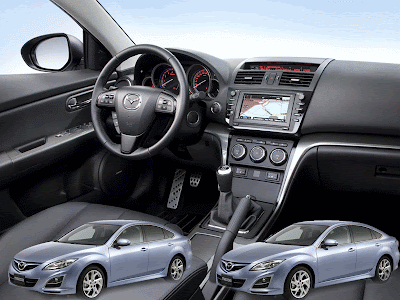
The Mazda6 second generation made its premiere at the 2007 Frankfurt Auto Show in September. The new Mazda6 is based on the Mazda GH chassis platform, a revised version of the GG chassis which Ford also still uses as their CD3 platform. Mazda continues to provide three body styles, including 4-door saloon (sedan), 5-door hatchback and wagon. A number of journalists have already praised its electrically assisted steering for being considerably improved compared to the last generation, providing more feedback to the driver. The hatchback model even has a trunk space which beats the larger rival Ford Mondeo/Opel Insignia (hatchback) by 200 liters with rear seats folded down. This model of the Mazda6 was awarded 2010 Family Car of the Year by What Car? magazine. The North American version was redesigned for the 2009 model year. It is a widened and lengthened version of the model sold elsewhere, with larger engines. Reviewers have noted its coupe-like roofline and sportier style. North American engine choices include a new 2.5 liter 4-cylinder and North American versions get the 3.7 liter V6 which is also available in the Mazda CX-9. Motortrend recorded a 0-60 mph acceleration time of 6.1 seconds for the Mazda 6 V6. For the North American market, only a sedan model will be available. A Mazdaspeed 6 variant has not been announced. Despite the North American version's increase in dimensions, Mazda maintains that the 6 retains the overall driving experience is still sportier than rivaling Accords, Camrys, or Malibus. Early reviews have been favorable. At the 2010 Geneva Motor Show, Mazda was pleased to show their new 2011 Mazda6. The United States are supposed to get theirs later this year or next year. In Road&Track magazine they added "The Mazda6 sedan gets a minor makeover with new headlights, foglights and 17-in. alloy wheels. Inside there are new cloth seat materials, a new steering wheel and door armrests, and a rearview camera now comes standard on Grand Touring models." And Mazda has confirmed that it will also happen on all 2011 models. Touring Car class. In 2009, they finished 2nd in the manufacturer's championship with 65 points, behind Acura. In 2007, Mazda won its first manufacturers championship in the class. The Mazda 6 is also used in the KONI Challenge Series Sport Touring class. It is currently used by the Baglieracing team with Dennis Baglier, Chris Gleason, and Marty Luffy as drivers.
Earlier today, we told you about the Australian market Mazda MX-5 Special Edition featuring a sports suspension kit and some exclusive styling touches. Well, we now learn that the same model will be offered in the States in a limited run of 750 units, albeit at a much lower price as the U.S. version starts at $30,925 with a manual transmission, and $31,525 when equipped with the six-speed Sport AT automatic. That's compared to US$47,800 for the Aussie market model. Read more »
A new special edition version of the MX-5 with some very minor styling and suspension upgrades has been added to Mazda's vehicle range in Australia. A total of 200 MX-5 Special Editions are being brought into the country with Mazda announcing that the upgrades are being added at no additional cost.However, this should not comfort Australian buyers as the list price of the limited edition model is a hefty AUS$47,200 (~US$47,800), or roughly the same as a 430HP 2011 Corvette Coupe (US$48,950) in the U.S. We understand that prices between different markets are not comparable for a variety of reasons, but close to $50 grand for an MX-5? Read more »
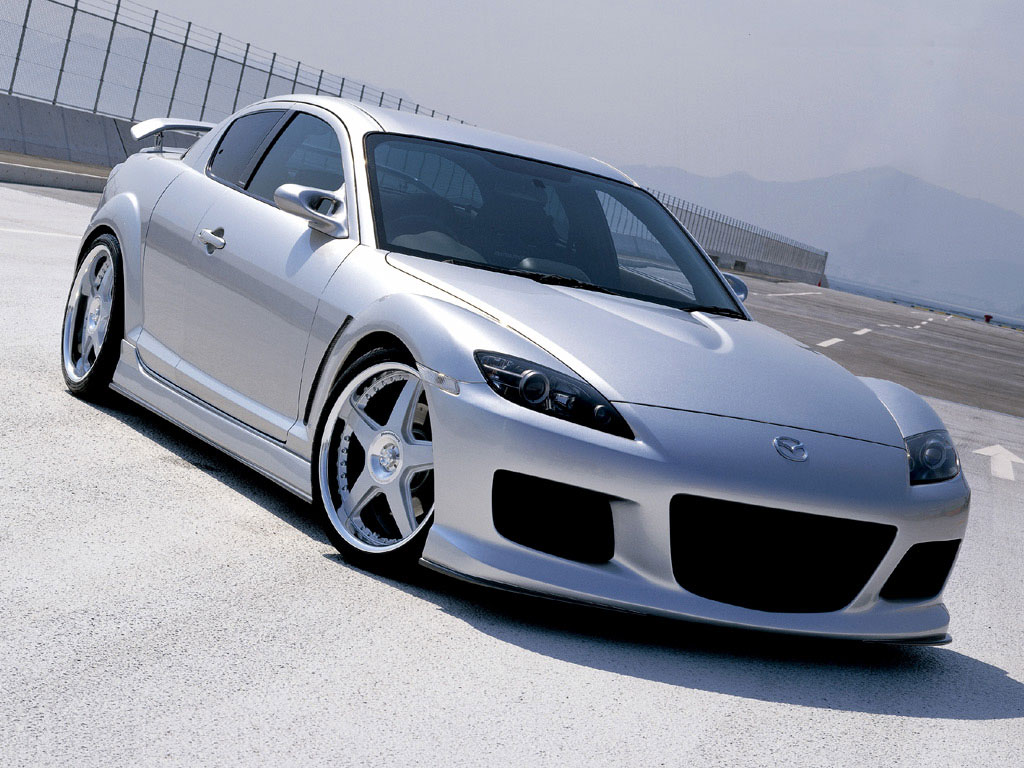
The Mazda RX-8 is a sports car manufactured by Mazda Motor Corporation. It first appeared in 2001 at the North American International Auto Show. It is the successor to the RX-7 and, like its predecessors in the RX range, it is powered by a rotary engine. The RX-8 began North American sales in the 2004 model year.Mazda introduced rotary engine vehicles in the US in 1971, beginning with the R100, followed by RX-2, RX-3, RX-4, RX-5, and finally three generations of the RX-7 sports car. However, the lack of creature comfort and user-friendliness, coupled with the high price tag and declining interest in sports cars and coupes at this time, led Mazda to pull the RX-7 from most major markets except Japan. After 1995, Mazda suffered from a relatively undistinguished product line in the US save the MX-5 Miata. As popular interest in import tuning and performance cars resurged in the late-1990s, thanks in part to various popular cultural influences such as the Sony PlayStation video game Gran Turismo, Japanese automakers waded back into the performance and sports car market in the US. In addition, Mazda endeavored to rejuvenate itself around this time, partially with financial and management assistance from Ford, and successfully developed a new product line of high quality cars with desirable styling and superior driving dynamics, beginning with the Mazda6 and followed by the Mazda3, paving way for the arrival for Mazda's next-generation rotary sports car.
Blue Mazda RX-8
Mazda RX-8 Speedometer
Development of the RX-8 can be traced to as far back as the 1995 Mazda RX-01 concept car, which featured an early iteration of the 13B-MSP engine. Naturally aspirated with side exhaust ports, this engine produced 220 hp (160 kW). As prohibited by Mazda's financial state at the time and the growing market interest in SUVs, the RX-01 never saw further development or production. However, a "skunkworks project" engineering team within Mazda kept the development of the 13B-MSP alive using MX-5 Miata chassis, eventually catching the attention of management, which at this time had come under heavy influence from Ford. Development of the 13B-MSP advanced and eventually led to the RENESIS moniker debuting along with the RX-EVOLV concept car which began to bear semblance to the production RX-8 with the "freestyle" rear suicide doors. Styling was developed via design competitions in Mazda tradition among its design studios in Japan, the US, and Europe. The project obtained official approval from management, and eventually the RX-8 concept car (design/engineering model) was produced and shown in 2001, closer resembling the production version. A near-production "reference exhibit" RX-8 was shown shortly thereafter at the 2001 Tokyo Motor Show, pending final approval for production. Production RX-8 closely resembles this vehicle save for minor trim details, and "job 1" began in February 2003 at Mazda's Hiroshima plant in Japan. The RX-8 was designed as a front mid-engine, rear-wheel drive four-seat four-door coupé. The car has 52:48 front-rear weight distribution, and a low Polar Moment that is achieved by mounting the engine behind the front axle and the fuel tank ahead of the rear axle. The front wheels feature classic independent double wishbone suspension, while the rear are independent multi-link. Weight is trimmed through the use of materials such as aluminium and plastic for several body panels. The rest of the body is steel, save for the plastic front and rear bumpers. The manual gearbox model uses a carbon fiber composite driveshaft to reduce the rotational mass (moment of inertia) connected to the engine. Power is sent to the rear wheels via a Torsen limited slip differential for improved handling. While its not quite in the league as the last RX-7 in terms of raw performance, the RX-8 is considered its successor as Mazda's rotary engine sports car. Its layout and clever engineering, along with typical Mazda suspension tuning, have endowed it with excellent driving dynamics which have garnered much praise and numerous awards. It has also proven popular in Japan among car enthusiasts as well as aftermarket equipment manufacturers and professional tuners. A prominent feature of the RX-8 is a pair of rear-hinged "freestyle" doors (similar to suicide doors) in order to provide easier access to the rear seats. The RX-8 has no B-pillar between the front and rear doors, with the leading edge of the rear door acting as a "virtual pillar" to maintain structural rigidity. Because of the overlapping design, the rear doors can be opened only when the front doors are open. Although by no means expansive, the RX-8's cabin was designed to allow enough room to house four adults, making it a genuine 4-seater rather than a 2+2. The first version of the RX-8, chassis code SE3P, was produced from model year 2003. It is powered by the RENESIS 13B-MSP (multi side port) Wankel rotary engine displacing 1.3 litres (2x654 cc). At launch, the RENESIS was available in standard and high power versions. The 4-port standard RENESIS produced 210 hp (160 kW) and was coupled with either a 5-speed manual or 4-speed automatic transmission. The 6-port high power RENESIS was only available with a six-speed manual transmission and was rated at 250 hp (190 kW). For the North American market, Mazda revised the reported output rating of the standard and high power RENESIS soon after launch to 197 hp (147 kW) and 238 hp (177 kW), respectively.[2] With exhaust ports now located in the side housing, the RENESIS boasted improved fuel efficiency and emissions rating over the 13B-REW employed by the last RX-7, thereby making it possible to be sold in North America. At launch, the RX-8 was available in various models in different markets around the world. Standard models include: * 6-speed manual "High Power" with a claimed output of 184 kW (250 PS; 247 hp) and a 9,000 rpm redline (Sold in NZ). This model was equivalent to the "Type S" trim in Japan. * 5-speed manual "Standard Power" tuned to 141 kW (192 PS; 189 hp) with the redline reduced to 7,500 rpm. This powertrain combination was not available in North America. * 4-speed automatic tuned to 141 kW (192 PS; 189 hp) in some markets (NZ), while the U.S. automatic is stated to deliver 158 kW (215 PS; 212 hp) . * 6-speed automatic (available in the U.S. market after 2006) developing 158 kW (215 PS; 212 hp) and 159 lb·ft (216 N·m) of torque with a redline at 7,500 rpm.[3] This was the revised standard RENESIS, now with two extra intake ports like the high power version.
Automatic versions all had low output/low rpm engines due to the lack of availability of a transmission that would reliably turn 9,500rpm.
Mazda RX-8 Interior
Mazda RX-8 Engine Detail
For 2009, mazda engineers improved the RX-8 body rigidity through the addition of structural reinforcements, by adding a trapezoidal strut tower bar and enhancing the local rigidity of the front suspension tower areas. The 2009 RX-8 is also 90 lbs lighter than the previous (2003-2008) models. Also, the rear suspension geometry has been reconfigured for better handling by improving drivshaft rigidity, lowering NVH levels, and improving overall performance. The 09 RX-8 has a different gearing ratio (on manual transmission-equipped cars) that is lowered from 4.444 to 4.777 for improved off-the-line performance. While minimal, these performance changes give the 2009 RX-8 increased acceleration and performance, as well as even greater responsiveness to the accelerator pedal. Mazda claims that the 09 RX-8 is a significantly faster car than the previous (2003–2008) model car due to the lighter weight, lowered gearing, and improved suspension. The 2009 RX-8 also receives design enhancements that are meant to freshen the styling and give the RX-8 a new look, without impairing the basic design theme. Refinements for the 2009 model year include a more aggressive restyled front and rear bumper as well as a new front fascia. The 09 RX-8 also comes with sporty, high-quality finish front and rear headlamps as well as larger exhaust pipes (now measuring 90 mm across). The 2009 RX-8 also offers a new five-spoke wheel design featuring a symbolic and sporty design reminiscent of the rotary engine, with different arrangements for each wheel size. There are currently three trims available to consumers: Sport, Grand Touring, and R3. Mazda North American Operations extended the engine warranty on RX-8s built between 2004 and 2008 to 8 years or 100,000 miles. The warranty extension covers the engine core which consists of the rotor housing and internal parts as well as the seals and gaskets. A copy of the extended warranty can be found at Racing Beat's websiteMazdaspeed, Mazda's in-house tuning and high-performance arm, has produced various after-sale parts and accessories for the RX-8, including full body kits, suspension upgrades, engine upgrades (such as cold air intake kit and catback exhausts), and various interior accessories. In addition, Mazdaspeed has also produced several series of showroom-ready limited-production RX-8s in Japan featuring some of these parts and accessories. To date, however, there has not yet been a full Mazdaspeed-tuned RX-8 along the same line as the Mazdaspeed6 or Mazdaspeed3. The RX-8 has been campaigned and used in various racing series by privateers. It has seen a considerable amount of success, the most prominent of which being the 2008 and 2010 24 Hours of Daytona GT-class wins campaigned by SpeedSource Race Engineering. This victory also marks the 23rd endurance race win at Daytona by Mazda rotary-powered race car. While the cars are powered by the 20B rotary engines, the car is in fact built on a tube frame chassis and not on the production car. Ryan Eversley won both races of the 2010 SCCA World Challenge Mid-Ohio Grand Prix in the touring car class. Other racing series include the KONI Challenge Series in the Street Tuner class. In the UK, the RX8 featured in the Mazda sponsored "Formula Women" series (2004), which involved all women drivers with slightly modified RX8s, and the RX8 was also run successfully in Britcar series endurance races (2005 / 2006) In Belgium, Mazda are currently sponsoring an RX8 silhouette racer in the GT series. The next generation rotary engine, dubbed "16X," is currently under development. Rumours also suggest that the RX-8 may be replaced by a new smaller, lighter, simpler rotary engine sports car similar in spirit to the original RX-7 and set to compete with the likes of the upcoming Toyota FT-86. Some sources would think the redesigned next generation model will replace it.As of October 2006 the RX-8 has won at least 37 international motoring awards including 2003 International Engine of the Year, the 2003 Japanese Car of the Year, Australia's Wheels magazine's Car of the Year for 2003, the 2004 Singapore Car of the Year, the 2004 U.S. Best Sports Car, and several UK Best Car Awards. It was named on Car and Driver magazine's Ten Best list for 2004, 2005, and 2006. It also took home 1st place on Car and Driver's "Four of a Kind" comparison test. 2010 RX-8 R3 edition placed 3rd out of 7 on Car and Driver's The Best-Handling Car in America for Less Than $100,000.